Imagination was given to man to compensate him for what he is not, and a sense of humor was provided to console him for what he is. - Oscar Wilde
![]()
Top Posts
Recent Posts
Favorite Animators
Categories
Archives
Join 137 other subscribers
Animation, Art, and Other Shiny Things
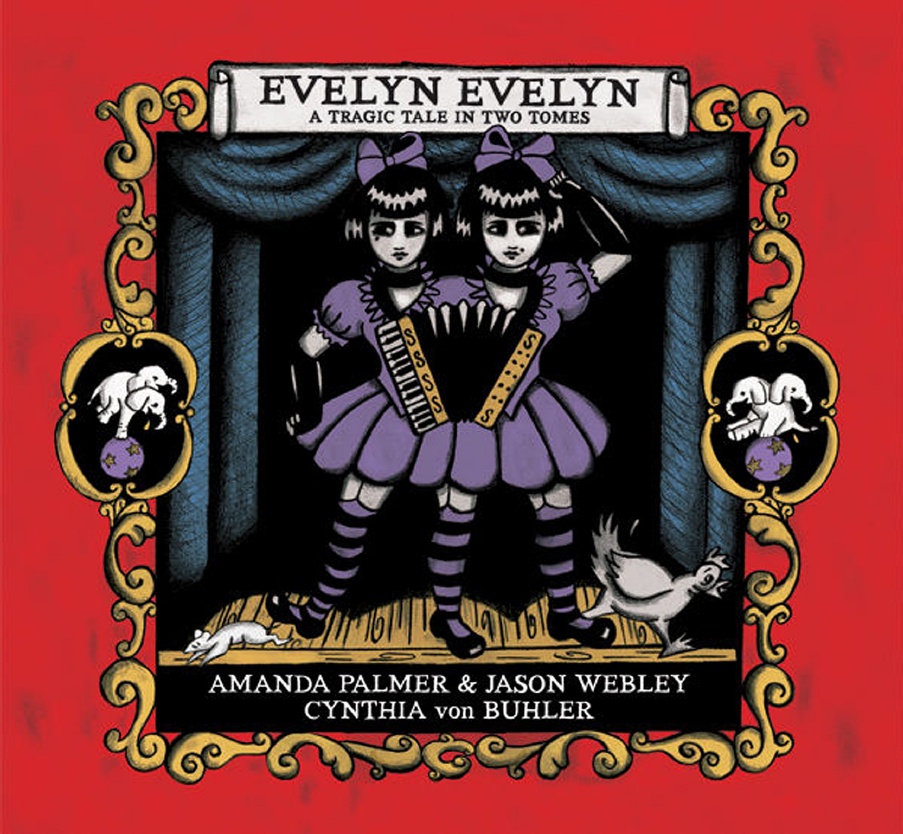
This is that post I mentioned in the Have You Seen My Sister Evelyn post, and Cynthia von Buhler is the artist that sent me down this rabbit hole.
Ms von Buhler not only drew the cover art for the Evelyn Evelyn album, but joined Mr Webley and Ms Palmer in creating a companion book to the disc that further details the lives of Eva and Lyn Neville:
Enthusiasts of genuine tragedy and celebrity intrigue, gird your mental loins for an authentic tale of unbelievable hardship and epic catastrophe! This wholly true and accurate account details the extraordinary lives of Evelyn and Evelyn, a darling but unfortunate pair of conjoined twins who brave extreme circumstances of calamity and adversity
…and while poking about on the intertubes to learn more about the Evelyn Evelyn album I went through a side door somewhere and ended up at one of those pages that is art. (and i don’t assign that lightly. at least i hope not… the word really deserves a completely different font as well, but you have to work with what you have)
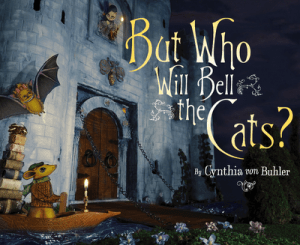
It is digital magic when an artist’s work and the internets come together to make more than the sum of each (remember retropolis?) and But Who Will Bell The Cats is a terrific example. Another of Ms von Buhler’s sites, The Cat Who Wouldn’t Come Inside, is also a work of art.
Ms von Buhler has illustrated several children’s books, but The Cat Who Wouldn’t Come Inside and But Who Will Bell the Cats? are the only two with their own websites. (though you can get a look inside any of the books in the library) BWWBTC is her latest and looks to be the first Ms von Buhler has also written.
Cynthia von Buhler is an internationally exhibiting visual artist, illustrator, children’s book author, and performer living in New York City. Von Buhler uses traditional as well as unconventional media: painting, sculpture, performance, video projection, installation, living fauna, collage, photography, human detritus, and electronic audio. By innovatively combining these media, often enhanced with text and electronics, von Buhler’s canvasses frequently become elaborate kinetic installations. In March 2006, Art & Antiques named von Buhler “one of the top contemporary surrealists”, however she has also been linked to the Fluxus movement.
The sculptures she creates for these two books are rich and warm and invite you to poke around looking for the little details and surprises. (the reason the books are so popular with kids, no doubt. the library got a dozen copies or so of both books a few weeks ago. got several of evelyn evelyn too, for that matter. but i digress…)
The same attention is given to her websites as well and is what puts them on my ‘best of’ list. Ms von Buhler’s primary site is at cynthiavonbuhler.com and her blog, or rather, one of her blogs is at cynthiavonbuhler.blogspot.com. Both are incredibly packed pieces of imaginary real estate and, much like her books, are great places to poke around in – you’ll never know what you’ll see next or where you’ll end up. Just trying to find the way back to something often has me finding something new. They are also fairly well linked together, so you can pretty much start on any one of Ms von Buhler’s sites and find yourself on her bio page as easily as on the ‘Find the Mouse‘ card trick page. I heartily endorse the ‘click everything’ method of site exploration.
As a teen back in the 70’s I spent a good amount of time prowling the twisted little by-ways of the Pike Place Market. The tourists generally stuck to the open and obvious areas of the Under-Market and if they did wander down the small meandering hall branches beneath the fish market and farmer’s stalls most often they were lost.
And all the better, in my opinion. Back there was no place for tourists. Back there were the tiny artisan shops where niches were filled and cultures were served. Controversial rubbed elbows with the obscure and the unusual. Back there wasn’t so much a different Market, but the essence of Pike Place sensibilities in it’s purest form: local globalism with a craftsman’s eye.
One of my regular stops was a little head shop tucked well away from oft-traveled paths. There, besides the regular plethora of glass and soapstone, were brilliant tied-dyed clothes, psychedelic posters, funky boxes, dragons and faeries sitting on or clutching crystals, and of course, magazines.
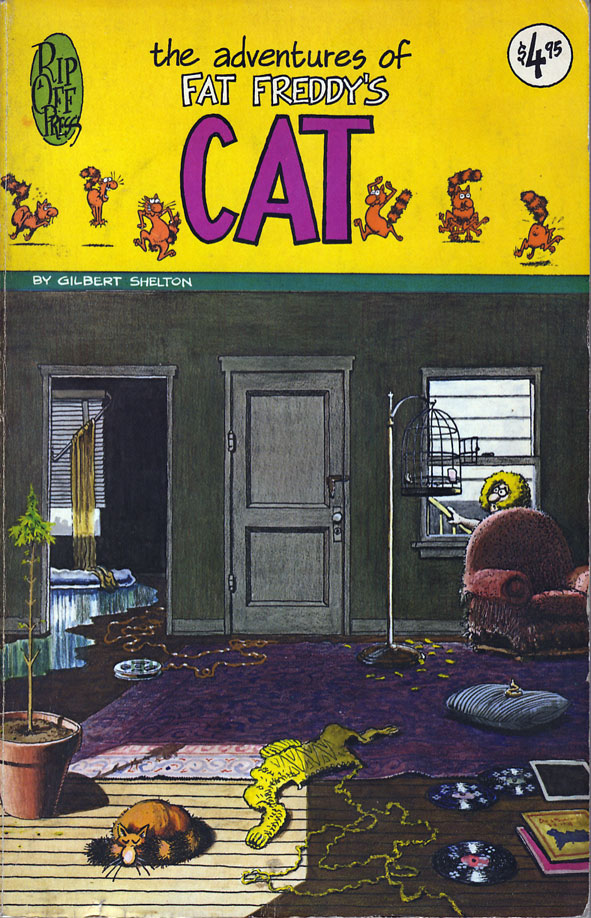
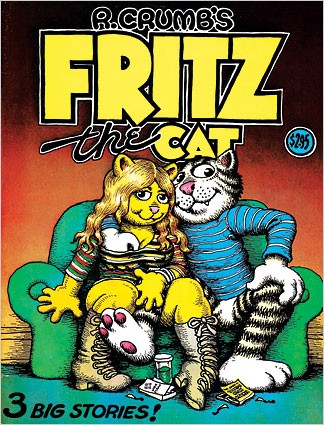
And there, courtesy of Fat Freddie’s Cat, I was introduced to underground comix. These weren’t your everyday Superman issue – they were outrageously illustrated and full of sex and drugs (and rock-n-roll too), They not only showed you stuff your parents didn’t want you to see, but poked fun at things your parents took seriously. These didn’t just tip sacred cows – this spun them around a few times, gave em ten bucks in singles, and set ’em up in stage-side seating. Here was a way for cartoonists from the underground newspapers to expand their stories and stretch their art as well.
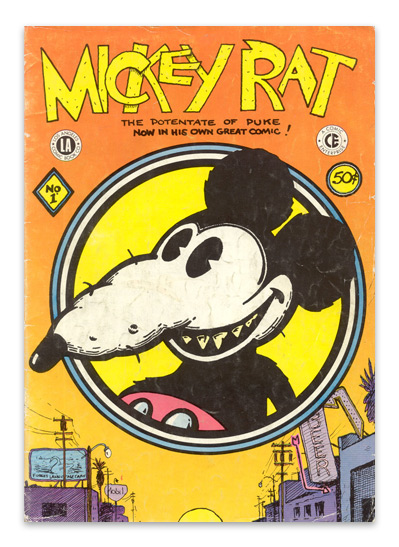
The Fabulous Furry Freak Brothers, Zap, Fritz the Cat, Mickey Rat, and eventually Heavy Metal. (i’m not sure HM actually fits in as an “underground comix”, but at that time, since it had sex and drugs and was definitely NOT for kids it was relegated to those racks)
And in all those pages I came across the art of Robert Crumb. Certainly the illustration is top-drawer, and I love the way he draws his women, but what reeled me in was the angst. Self doubts, internal turmoils, and everyday demons infuse his work, all cranked up to eleven – I could understand that and still do – I related.
Over the years R Crumb got out of the underground comix biz and he began to pursue more mainstream applications of his considerable talent including album covers and illustrating some of the American Splendor issues. One of his most recent endeavors was the illustration of Genesis, the first book of the Bible.
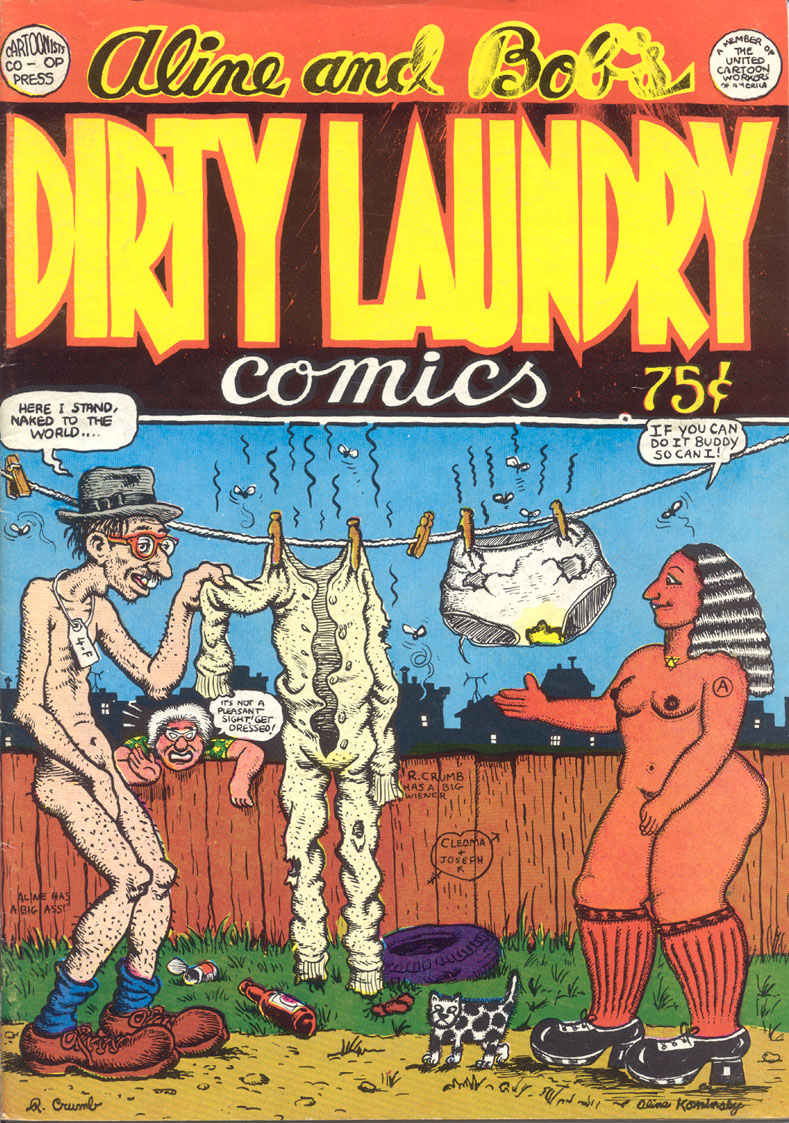
He married Aline Kominsky in 1978 and they’ve collaborated on several projects over the years, she being a cartoonist in her own right. Apparently, friends of Mr Crumb had noticed a resemblance, in both name and curvature, between Ms Kominsky and a drawing Crumb had done for Snatch Comics #1 depicting “Jail Bait of the Month, Honey Bunch Kaminski” around 1968 (you’re gonna have to google that one yourself) and thought to introduce them. One of their most notable collusive efforts has been a series of domestic tales, called Dirty Laundry, where they each draw themselves. (later along their daughter Sophie joined in) I’ve seen (and may even have — somewhere) several of those comics and it’s striking to see the obvious differences in drawing style within the same panel.
Fantagraphics here in Seattle has published a series of his comics and sketches under the title The Complete Crumb (of course it’s not ‘complete’, but at 17 volumes it’s intensely comprehensive) and Taschen published a limited edition (1000 copies, signed and numbered) Robert Crumb’s Sex Obsessions in 2007. They’re still available and run about $700. Fortunately, for the rest of us they’ll be releasing an unlimited run at the end of next year; December 12th, to be precise. (so depending on which math you use in your end-of-the-world calculations you’ll get it on The Rapture, or a bare week or so prior. In either case, the mere possession of it will insure you won’t be going anywhere. but i digress…)
Speaking of which,
Robert and Aline have finished their latest twelve-page strip, so this and all of their collaborations will be compiled into one book called Drawn Together. That will be released this fall in France and by Norton in the U.S. at the beginning of next year. This summer, Robert is organizing and compiling his sketchbook pages to be published in an upcoming release by Taschen. It will be in ten volumes, containing the works of his sketchbooks done between 1964 until the present.
That’s via the Official R Crumb Website. There’s alotta stuff available for the Crumb connoisseur to purchase (i think there is a brother-in-law involved here somewhere, so that probably explains that) but with my measly wallet contents I stick to the About pages. And there is a spot well worth an extended perusal.

R Crumb and The Cheap Suit Serenaders played 1920's tunes in the way of the day. This CD was given away with The R Crumb Handbook
What I think many folks may not know about Mr Crumb is his long time love of 1920’s and 30’s blues and jazz. To this end he’s not only produced trading card sets of “The Heroes of the Blues“, “Early Jazz Greats“, and “Pioneers of Country Music” but also included a CD of many of these musicians’ work in a book that collected the 3 sets into a single volume called R Crumb’s Heroes of Blues, Jazz and Country.
Besides drawing album covers for many-a old-timey music release, in the 1970’s he formed R Crumb & His Cheap Suit Serenaders and regularly joins Eden and John’s East River String Band on Mandolin. You can catch more of their tunes on YouTube. (its really quite good, imho)
And finally, for a good view on Mr Crumb’s life and work, check out the 1994 documentary Crumb. A good glimpse into the world of a gifted artist.
Whatever the subject matter or genre – if I read book 1 of a series, the rest will fall, in order. Perhaps I should qualify that; if I can complete book 1, then I am compelled to read the rest of the series.
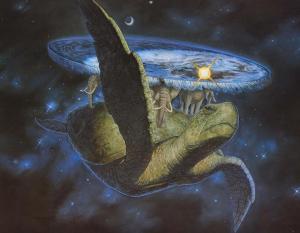
This is a terribly important trait in what otherwise is a compulsive idiosyncrasy as it saves me from plowing my way through encyclopedias and Harlequin romance series.
I have suffered through some atrocious monstrosities disguised as paperback entertainment because I held the vain hope that the story would get better. And then book 1 ends and I’m committed…
Working at a library only feeds the problem: even before book 1 is complete, book 2 either on the reserve shelf with my name on it, or on it’s way. Most often, though, I already have it checked out, providing me further inducement to complete book 1.
It can be vicious.
I still shudder when I recall that sci-fi quadrilogy whose books averaged over 600 pages each.
When you begin to despise a character for their blinding stupidity and begin to harbor a vain hope they get “removed” in a story-line-appropriate manner (or at least injured) then you’re generally in for continued disappointment until you can close the back cover of the book. (there is a potential for ‘lingering disappointment’ reserved for the exceedingly pin-headed character’s continued existence… Need I make reference to Jar-Jar Binks? No, I thought not…)
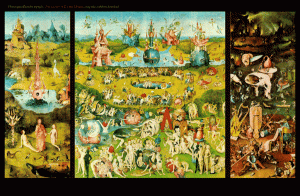
![Bosch-garden of earthly delights [1024x768]](https://ruffledcrow.com/wp-content/uploads/2010/12/bosch-garden-of-earthly-delights-1024x768.gif?w=300&h=195)
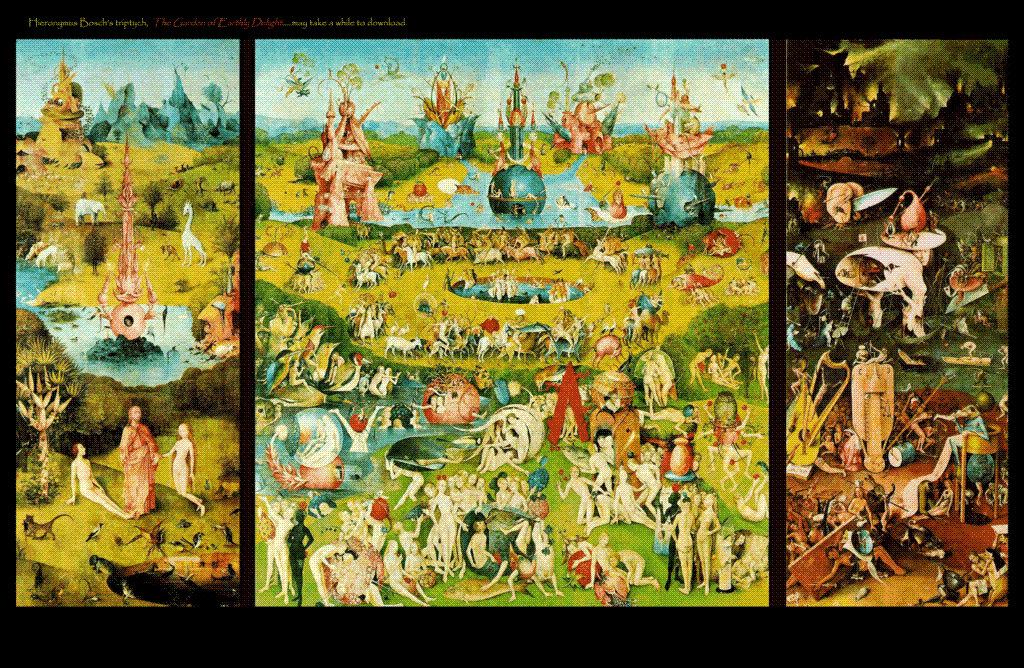
"Garden of Earthly Delights" (ca 1503) by Hieronymus Bosch - Yes, there is a reason it's in this post. Two of them, actually. Figure it out for yourself.
Now before you get all bent out of shape and petulantly expound on how much your little gray cells work out during the perusal of a Spenser or Bosch tale, let me note that a mystery novel is still merely a relatively small set of clues couched in a large number of semi-associated ideas.
If were much more than that it would be a textbook, or at least be so convoluted as to be unreadable for entertainment. Having to take notes just to keep the story straight really kinda takes the fun out of reading a novel. But I digress…
Amidst the mountain of potentially unfortunate reading material I occasionally do luck out and dive into an exceptional series of books – despite the generally trashy genres I tend to enjoy. Xanth and Discworld are two places I love visiting. As a kid I visited and revisited Narnia alot.
And that is a snapshot of the problem; Xanth is contained in over 30 novels, Discworld in near 40 (Spenser too), Harry Bosch in over a dozen. All other reading materials are forsaken in favor of another world clothed in a character of words until the last page of the last book.
Worse still, I can’t read multiple books during a series. If I am pondering Seldon’s psychohistory, then walking into a Bene Gesserit Chapter House could induce a stroke. I know this because I tried once. Was out of sorts for several days.
Common Wisdom says that if you know you have a problem then you’re on your way to solving it. The corollary is that if someone else knows about that problem, they can use it against you.
And that’s what happened…

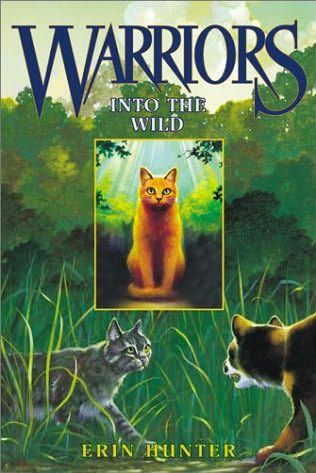
Book 1 of the Warriors multi-series. Some of the books in this series cause actual pain when read by anyone who has been a parent.
I’ve know Merc for over two decades, we’ve played many a game together – on the same side and against each other. Of anyone, Merc knows my strengths and weaknesses and knows how to lever either of them.
With full knowledge, and malice aforethought, he brought me a book 1.
The Warriors series is up to somewhere around 3 dozen books including prequels, guides, and mangas. Into the Wild is the first of a 6 book sub-series set in the Warriors world. Written to the pre-teen and young teen audience, it follows ‘clans’ of cats as they struggle to survive. It idealizes and anthropomorphizes cat culture a bit, but the underlying themes of loyalty, trust, and achievement are good ones. Watching the characters work their way through worry and self-doubt shows the young reader that they aren’t alone. It’s engaging, and a lifetime of Disney helps me to suspend my disbelief in favor of my new friends in Thunderclan.
It took me about 3 books to realize I was reading the books like a parent. An affliction that continues to plague me as I’m beginning book 1 of the 3rd series. (multiple book 1’s in a single series is particularly malevolent, by the way) It’s like watching the kids go through middle school all over again. Painful…
In an off-handed way, though, being in the middle of a large series is somewhat comforting; I know the next book I will be reading.
And best of all? I am protected from the other book 1’s out there.
Most often the beauty of a book is contained within it’s words, sometimes it’s the rich cover or heavy paper, maybe it’s the art- or information-filled photographs.
But a few artists are bringing out a book’s different kind of beauty.
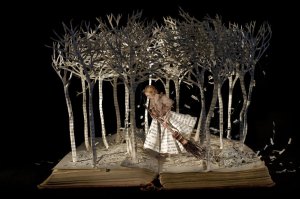
Su Blackwell creates some stunning art from old books; beautiful scenes reminiscent of the classic places and tales of youth.
She has also ‘sized up’ her art for commercial installations to great effect.
To my mind’s eye, however, a book is more than just a medium.
Every single book is printed for a reason. It’s not always a good reason, but enough of one to get it to press at least. What is held between the front and back cover is the reason for it’s existence. The very soul of the book.
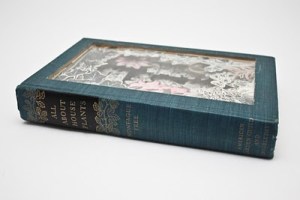
And in a very interesting way Julia Feld has been baring those souls of select books.
Favoring out-of-date reference books Ms Feld uses various sharp implements and plenty of glue to create these intricacies that bring out the artwork within the book itself.
She’s building quite the gallery of beautiful work. Check it out at her Hokey Stokes! blog.
I grew up around books. Lots of books. I began to read them at 3, or so I’m told. I don’t remember a time when I didn’t read nor do I know how many books I’ve read, but I’d bet that number is somewhere on the upside of the average.
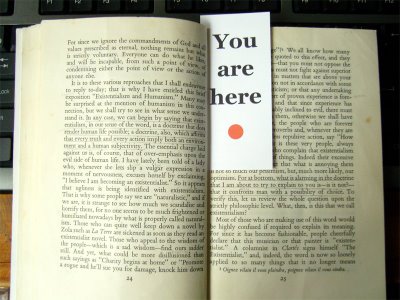
And because of this I’ve always had bookmarks too. In my mind, dog-earing a page corner is akin to writing in the margins – a cardinal sin, but occasionally necessary, and only then if the book’s condition or value allows it.
Nearly every bookstore supplies their own bookmark, as do most libraries, civic activities and organizations, museums and aquaria, parks and playhouses. If you need a ‘real’ bookmark, something created for the task, they’re easy to find.
We all have certain favorite bookmarks that we struggle not to lose, but in a pinch any slip of paper will do. Or a leaf, a feather, a piece of string, a gum wrapper, a picture, a dollar bill, a magazine response card, a random business card, or possibly even a ticket stub to a museum in Italy.
And they aren’t just slips of paper, either – formed brass, punched tin, stamped leather, wood laminate, shaved bark, reflective plastic, magnifying plastics, light lace, pattern-woven linen, crushed reed – just about any material that is cohesive, and won’t get absorbed by the book’s paper can or has been used to note a spot in someone’s book.
“The choice of a bookmark is a matter of personal taste and civilization, show me your bookmark and I will tell you who you are.”
George Hartong
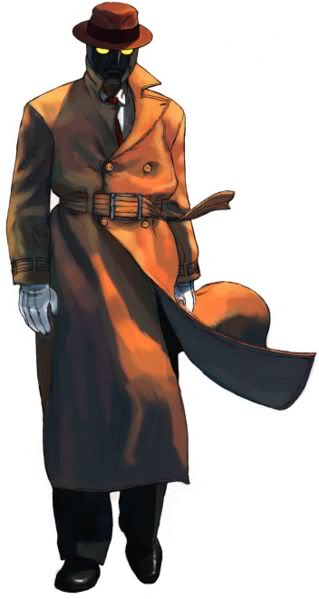
Hard boiled detectives aren’t only found in the pulps and, by necessity or chance, can be found on many a planet in the science fiction galaxy or fantasy universe. The uniform changes slightly from gumshoe to gumshoe, but the quick patter, ability to take a punch, and cynical streak of unbendable morality is consistent, even if it is hundreds of years in the future or hundreds of light-years into the beyond.
The first detective I met in the pages of a science fiction book was probably R. Daneel Olivaw in The Caves of Steel. He isn’t quite cut from the shamus twill of the paperbacks – he’s just a self-aware robot trying to help solve a crime amidst and despite anti-robot sentiments – but he introduced me to the idea that a SF detective novel could be written.
It’s been said that mystery and science fiction genres couldn’t be blended because you would naturally have situations or weapons that the reader had no reference to. The locked room mystery would be solved in 2 pages by the introduction of the Variable-Depth Instant-On Micro-Singularity Generator, for example. Pretty much the same for fantasy, though that would probably entail the old Triggered Heart Crush Spell of the Ancient Djooneormihntz. Anyways, they can be melded, and well. I’ve met many private eyes in my sci-fi reading career and here are a few of my favorites. Read more of this post