Pinball, much like the Guillotine, can trace it’s lineage back to 18th century France.
Prior to then, game tables were a way to bring outdoor games inside, or at least get them down to a manageable size. Bowling, curling, and croquet were only a few of the translated games. To befit the scale, rather than a mallet, the cue was created. (yes, the billiard table and the pinball table are branches on the same tree)
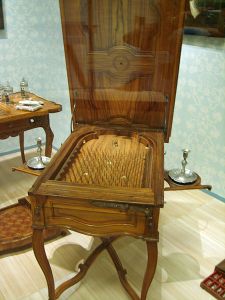
A Billard Japonais table ca. 1760
By the mid-1700’s, what came to be known as ‘Bagatelles’ (meaning ‘trifle’) had gone through an evolution away from the interminable re-setting-tiny-dowels-all-over-the-table-after-every-shot into more of a fixed-pin-obstacle-course-with-holes-in-it. Perhaps most recognizable as the link to the modern pinball table would be the Billard Japonais (‘japanese billiards’ even though it was actually invented somewhere in western europe)
…which used thin metal pins and replaced the cue at the player’s end of the table with a coiled spring and a plunger. The player shot balls up the inclined playfield toward the scoring targets using this plunger, a device that remains in use in pinball to this day, and the game was also directly ancestral to pachinko.
via
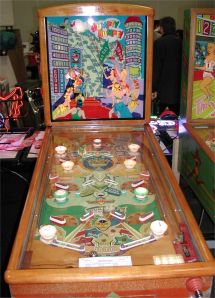
Humpty Dumpty - The first pinball machine with flippers. Three per side, in the wrong place, and facing the wrong way, but flippers!
I should note here that it took a century (until 1871, to be precise) before Montague Redgrave, a manufacturer of bagatelle tables in Cincinnati, patented the spring launcher. He also shrunk the new design enough to sit on a bar and by the 1930’s coin operated ‘pin games’ were becoming wildly popular. Throughout the 30’s pin tables were the focus of many innovations including the addition of electric lights, active bumpers and a full back-glass, but it wasn’t until 1947 that the flippers we know and love were introduced. (on gottleib’s humpty dumpty)
That said, a good part of the pin table’s appeal was also the ability to win prizes. A game of chance under glass lends itself well to gambling and several municipalities took note of that and outlawed the games in the early 1940’s. Even with the introduction of flippers about five years later adding an element of skill, it wasn’t until the mid-70’s that New York (among others) came to it’s senses and lifted the ban. (until at least the end of 2010, and likely still, pinball remains illegal in the town of beacon, ny)
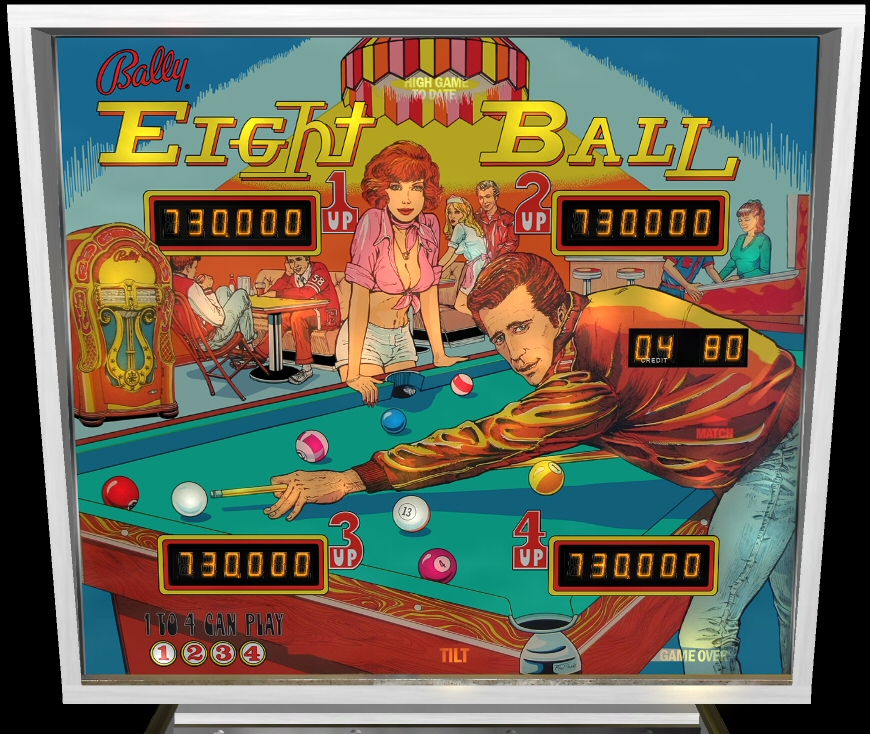
One of my favorite machines ever, Eight Ball. There was a "sequel" machine called Eight Ball Deluxe.
Around my neighborhood in the 60’s the local drug store and the laundromat had pinball machines. Not quite being of proper height and, well, being a bit young to earn my own dimes nor be allowed to spend the dimes I did have on such a wasteful, and potentially life-destructive ‘game’, it wasn’t until the early 70’s that I was able to perform the laying on of hands upon a pinball machine.
By that time the drug store had given up their machine, but as a wide-roaming teen I found alternate dens of iniquity enough to keep my slide into depravity sufficiently slickened; pizza and ice cream parlors, a couple grocery stores, the bowling alley, every single 7-eleven, and finally, an arcade!

Pinbot. I'll never forget the "chunk chunk chunk bwaaaaaaahhhh" as it reset the targets for multi-ball. That's not strange, is it?
Electric City (eventually ‘electric palace’ though that was putting on some outsized airs as it was still the dark and seamy little arcade it always had been) was packed with an air hockey table, a pong game, and a couple walls lined with pinball machines. That was where I fell in love with the game.
By the time the film version of The Who’s rock opera Tommy was released in 1975 I was good enough that I could break even or better on a night at the arcade by selling off my free games. I even attracted the (very) occasional crowd when I was having a good game.
Then they got wide and tilted and weird.
You always had the places that cranked up the back legs to increase the slope of the table, but add that to the new widebodies, upper playfields, and new designs that added more bells and ramps and bumpers and levels to lure quarters away from the video games – the pinball machine itself was getting buried.
Fortunately, even as the playfields were getting more complex and gordian, the backglass, and the playfields themselves, were being recognized as an art form.
In the second part we’ll take a look at Art in Pinball.
(no, there is no guarantee of when part two will show up. feel fortunate i decided to split up history and art or part one here would’ve bloated to a post of epic proportions and not been ready to post until sometime next year…)
Some significant dates in Pinball history:
1931 – Baffle Ball (D. Gottlieb & Co,) – First commercially significant game. Sold over 50000!
1931 – Ballyhoo (Bally Mfg.) – Ballys first game. Sold 75000!
1932 – Advance (Harry Williams) – First TILT-mechanism.
1933 – Contact (Pacific Amusement) – Game by Harry Williams, first time a mechanical device moving ball (an eject hole) and sound (a bell)!
1936 – Bally presents bumper in game Bumper.
1946 – Harry Williams starts Williams Manufacturing company.
1947 – Humpty Dumpty – (D. Gottlieb & Co.) – First game with flipperst!
1948 – Williams presents jet bumper in game Saratoga, and puts flippers on lower side of playfield.
1951 – Gottlieb presents a slingshot.
1954 – Super Jumbo (Gottlieb) – First 4 player machine.
1956 – Balls-A-Poppin’ (Bally) – First multiball.
1957 – Metal legs replace wooden ones.
1960 – Magic Clock (Williams) – First game with moving target.
1960 – Flipper (Gottlieb) – Extra Ball for the first time.
1962 – Vagabond (Williams) – Williams presents the drop target.
1968 – Williams increases flipper size from 2″ to their current size.
1972 – Williams uses DC powered solenoids.
1975 – Spirit of 76 (Mirco Games) (do not confuse with same title by Gottlieb) – First game to use a microprocessor.
1977 – Atarians (Atari) – First widebody machine.
1977 – Bally Eight Ball makes modern pinball sales record: 20230!
1979 – Gorgar (Williams) – First talking pinball.
1980 – Firepower (Williams) – First solid state multiball.
1981 – Haunted House (Gottlieb) – First three-level playfield.
1987 – Laser War (Data East) – New company presents first game with stereo sound.
1990 – Checkpoint (Data East) – First dot matrix display.
1993 – Twilight Zone (Williams) – More patents than any other game so far.
1998 – Williams presents new Pinball 2000 -system.
1999 – After two P2K games, Williams quits because of low demand.
1999 – Gary Stern buys Sega and continues as the only pinball producer under STERN brand.
Thanks to fliput.net for the date list!







 The Ruffled Crow